Tuesday, September 23, 2008

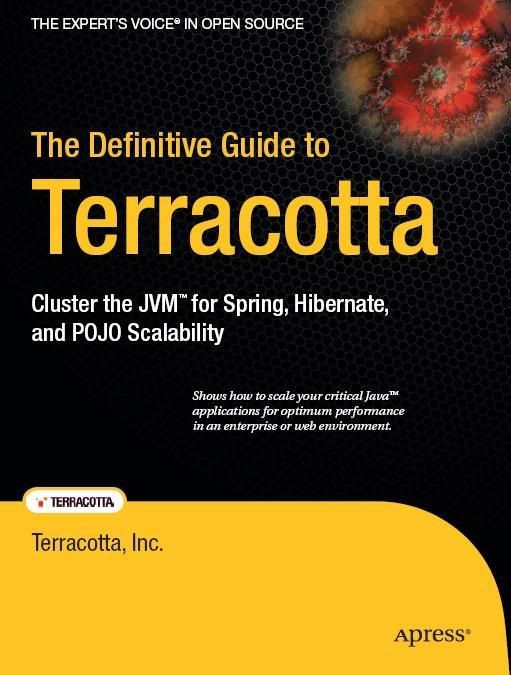
The Definitive Guide to Terracotta: Cluster the JVM for Spring, Hibernate and POJO Scalability


Get the definitive guide on all the fundamentals of Terracotta as well as user secrets, recipes, and prepackaged frameworks.

Written by Terracotta CTO Ari Zilka and his team, The Definitive Guide to Terracotta: Cluster the JVM for Spring, Hibernate and POJO Scalability covers the following:

* High Availability (HA) nth degree scaling and clustering for traditional J2EE and Java EE 5 applications (using Seam or other application) as well as Spring–based enterprise applications
* Everyday Terracotta using its prepackaged frameworks and integration recipes, including configuration and customization for your application tuning, no matter the scale
* Power user secrets available, including config modules, customized advanced performance tuning, SDLC, Maven, and more.

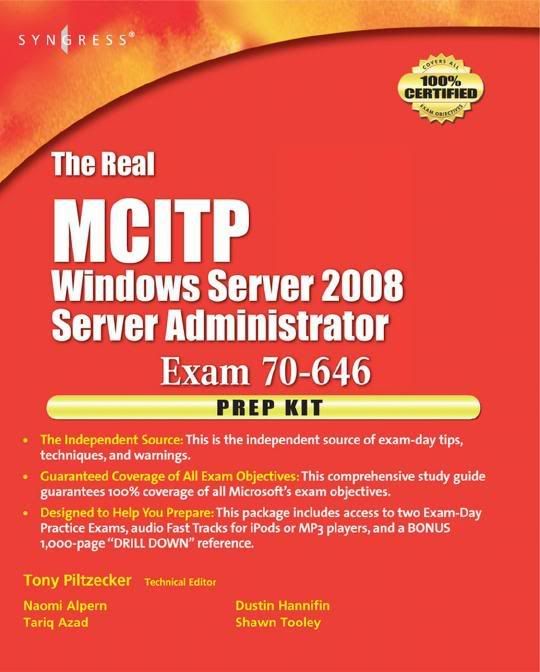
The Real MCTS/MCITP Exam 70-646 Prep Kit: Independent and Complete Self-Paced Solutions


This exam is designed to validate skills as a Windows Server 2008 Server Administrator. This exam will fulfill the Windows Server 2008 IT Professional requirements of Exam 70-646.

The Microsoft Certified IT Professional(MCITP) on Windows Server 2008 credential is intended for information technology (IT) professionals who work in the complex computing environment of medium to large companies. The MCITP candidate should have at least one year of experience implementing and dministering a network operating system in an environment that has the following characteristics: 250 to 5,000 or more users; three or more physical locations; and three or more domain controllers.

A MCITP Server Administrator is responsible for the operations and day-to-day management of an infrastructure of servers for an enterprise organization. Server administrators manage the infrastructure, web, and IT application servers, and use scripts to accomplish tasks on a regular basis. They conduct most server management tasks remotely by using Terminal Server or administration tools installed on their local workstation. MCITP Server Administrators also support engineering projects, and are responsible for server builds and configuration.

Thursday, September 18, 2008

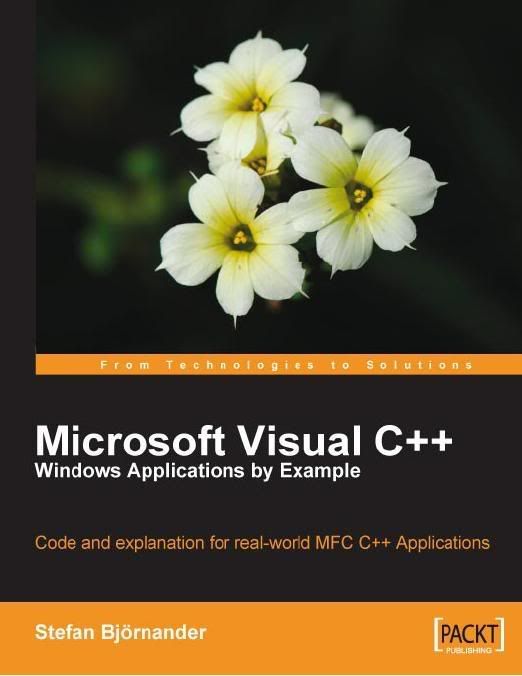
Microsoft Visual C++ Windows Applications by Example


With this book you will learn how to create applications using MDI, complex file formats, text parsing and processing, graphics, and interactions. Every essential skill required to build Windows desktop-style applications is covered in the context of fully working examples.

The book begins with a quick primer on the C++ language, and using the Visual C++ IDE to create Windows applications. This acts as a recap for existing C++ programmers, and a quick guide to the language if you’ve not worked with C++ before. The book then moves into a set of comprehensive example applications, presenting the important parts of the code with explanation of how it works, and how and when to use similar techniques in your own applications.

The applications include: a Tetris-style game, a drawing application, a spreadsheet, and a word processor.

If you know the C++ language, or another Windows-based programming language, and want to use C++ to write real, complex applications then this book is ideal for you.

Service Oriented Architecture with Java


Service Oriented Architecture provides a way for applications to work together over the Internet. Usually, SOA applications are exposed through web services.

Web services have been around for a while, but complex adoption processes and poor standardization hampered their use at first. However, with the adoption of new, simpler protocols such as REST, and major companies supporting SOA, the time is now right to adopt these standards.

This book will show you how to build SOA, web services-based applications using Java. You will find out when SOA is the best choice for your application, how to design a sound architecture, and then implement your design using Java.

The book covers the important web services protocols: XML-over-HTTP, REST, and SOAP. You will learn how to develop web services at all levels of complexity and for all kinds of business situations.

Active Directory Disaster Recovery


Murphy's law states that anything that can go wrong will go wrong. In relation to Information Systems and Technology this could mean an incident that completely destroys data, slows down productivity or causes any other major interruption of your operations or your business. How bad can it get?—"Most large companies spend between 2% and 4% of their IT budget on disaster recovery planning; this is intended to avoid larger losses. Of companies that had a major loss of computerized data, 43% never reopen, 51% close within two years, and only 6% will survive long-term." —Jim Hoffer, Backing Up Business – Industry Trend or Event.

Active Directory (AD) is a great system but it is also very delicate. If you get a problem, you will need to know how to recover from this situation. You will need to know about Disaster Recovery and be prepared with a business continuity plan. If Active Directory is a part of the backbone of your network and infrastructure, the guide to bring it back online in case of an incident needs to be as clear and concise as possible. If all of this happens or if you want to avoid all of this happening, this is the book for you.

Recovering Active Directory from any kind of disaster is trickier than most people think. If you do not understand the processes associated with recovery, you can cause more damage than you fix. This is why you need this book.

This book has a unique approach—the first half focuses on planning and shows you how to configure your AD to be resilient; the second half is response focused and meant as a reference in which we discuss different disaster scenarios. We follow a Symptom-Cause-Recovery approach—so all you have to do is follow along and get back on track.

This book describes the most common scenarios and how to properly recover your infrastructure from them. It contains commands and steps for each process and contains information on how to plan for disaster and how to leverage technologies in your favor in case of a disaster.

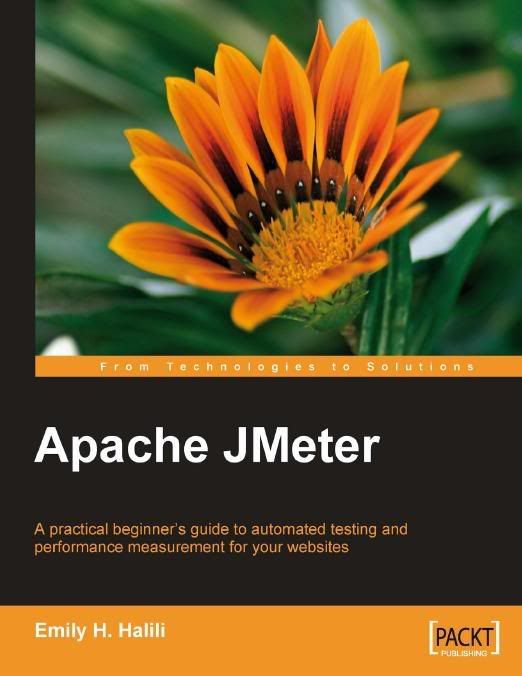
Apache JMeter


A bad response time on a website can drive away visitors and prospective customers. To measure what a website can handle, there should be a way to simulate and analyze different load scenarios—this is where a load-testing tool like JMeter comes in. JMeter is a powerful desktop performance tool from the Apache Jakarta project, written in Java, for load-testing web pages, web applications, and other static and dynamic resources including databases, files, Servlets, Perl scripts, Java Objects, FTP Servers, and more.

JMeter works by acting as the "client side" of an application, and measures response time. As such, it's one half of the testing arsenal; the other half consists of a tool to watch metrics on the server side, such as thread counts, CPU loads, resource usage, and memory usage. Although it can't behave like a browser to measure rich client-side logic such as JavaScripts or Applets, JMeter certainly measures the performance of the target server from the client's point of view. JMeter is able to capture test results that help you make informed decisions and benchmark your application.

This book introduces you to JMeter (version 2.3) and test automation, providing a step-by-step guide to testing with JMeter. You will learn how to measure the performance of a website using JMeter.

While it discusses test automation generally, the bulk of this book gives specific, vivid, and easy-to-understand walkthroughs of JMeter's testing tools showing what they can do, and when and how to use them.

Monday, September 15, 2008

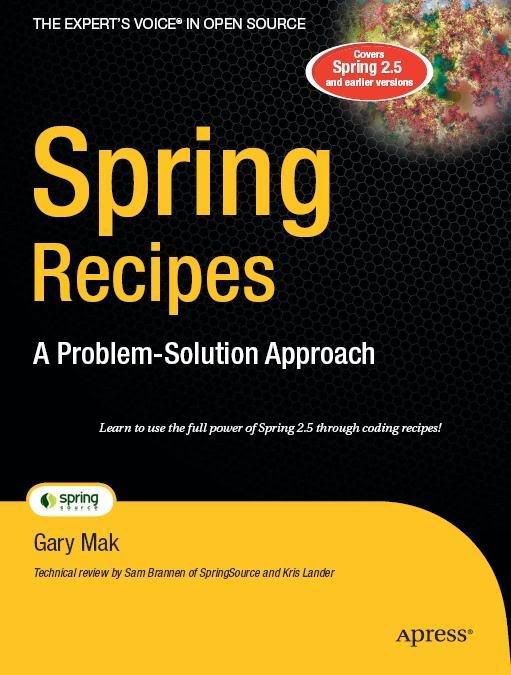
Spring Recipes: A Problem-Solution Approach


Spring addresses most aspects of Java/Java EE application development and offers simple solutions to them. By using Spring, you will be lead to use industry best practices to design and implement your applications. The releases of Spring 2.x have added many improvements and new features to the 1.x versions. Spring Recipes: A Problem–Solution Approach focuses on the latest Spring 2.5 features for building enterprise Java applications.

Spring Recipes covers Spring 2.5 from basic to advanced, including Spring IoC container, Spring AOP and AspectJ, Spring data access support, Spring transaction management, Spring Web and Portlet MVC, Spring testing support, Spring support for remoting, EJB, JMS, JMX, E–mail, scheduling, and scripting languages. This book also introduces several common Spring Portfolio projects that will bring significant value to your application development, including Spring Security, Spring Web Flow, and Spring Web Services.

The topics in this book are introduced by complete and real–world code examples that you can follow step by step. Instead of abstract descriptions on complex concepts, you will find live examples in this book. When you start a new project, you can consider copying the code and configuration files from this book, and then modifying them for your needs. This can save you a great deal of work over creating a project from scratch.

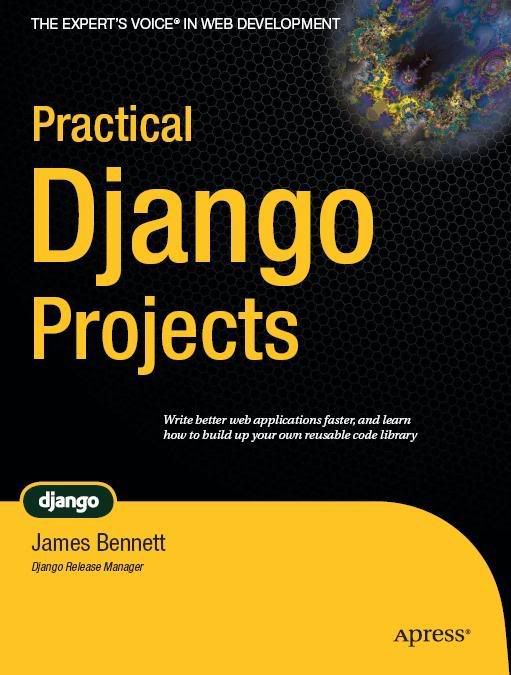
Practical Django Projects


Build a django content management system, blog, and social networking site with James Bennett as he introduces the popular Django framework. You’ll work through the development of each project, implementing and running the applications while learning new features along the way.

Web frameworks are playing a major role in the creation of today’s most compelling web applications, because they automate many of the tedious tasks, allowing developers to instead focus on providing users with creative and powerful features. Python developers have been particularly fortunate in this area, having been able to take advantage of Django, a very popular open source web framework whose stated goal is to “make it easier to build better web applications more quickly with less code.”

Practical Django Projects is the first book to introduce this popular framework by way of a series of real–world projects.


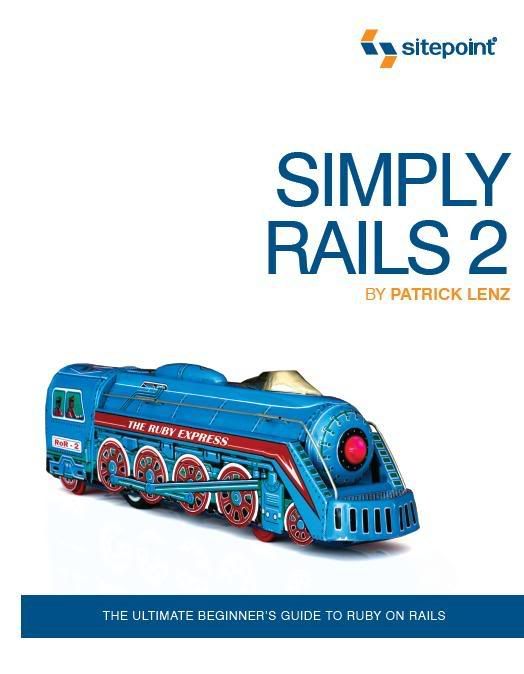
Simply Rails 2


Want to learn all about Ruby on Rails 2.0, the web application framework that is inspiring developers around the world?

The second edition of this practical, hands on book will:

* show you how to install Ruby on Rails on Windows, Mac, or Linux
* walk you, step by step, through the development of a Web 2.0 social news application, just like digg.com
* show you how to test, debug, benchmark, and deploy your Rails application

Unlike other Rails books, this book doesn't assume that you are an experienced web developer, or that you've used Ruby before. An entire chapter is devoted to learning Ruby in a fun way, using the interactive Ruby console, so you can follow along at home. You'll be an accomplished Ruby programmer in no time!

The example application that the book builds - a user-generated news web site - is built upon with each following chapter, and concepts such as sessions, cookies and basic AJAX usage are gradually introduced. Different aspects of Rails, such as user authentication, session cookies, and automated testing are explored with each feature that is added to the application.

The book finishes with chapters on debugging, benchmarking and deployment to a live web server.

By the end of the book, you'll have built a fully-featured Web 2.0 application and deployed it to the Web. And all code is up-to-date for Rails 2.0, so you can begin coding immediately with the latest version of Rails.


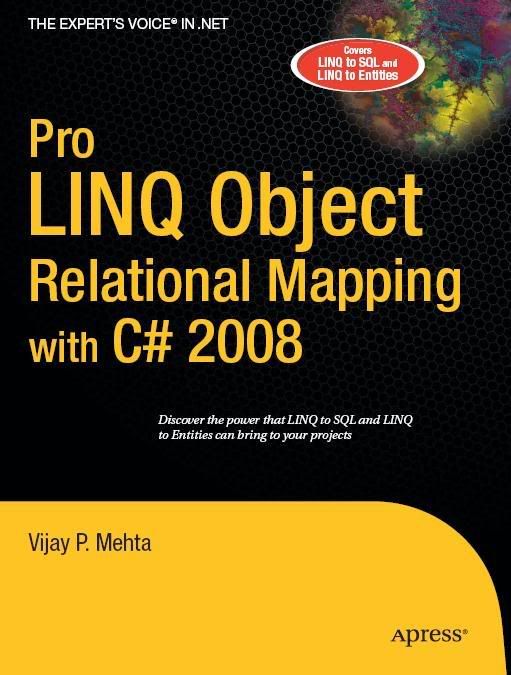
Pro LINQ Object Relational Mapping in C# 2008


It is nearly impossible today to write enterprise software without the use of one or more relational databases. Granted, there are cases when the data is transient and not stored in a database, but for the most part, software needs to consume and manipulate data in a database. It sounds easy, but there are hundreds of ways to connect software systems to databases and thousands of people who think they have the skeleton key for data access layers. Pro LINQ Object Relational Mapping in C# 2008 explains an efficient, repeatable way to apply industry design patterns to build scalable object–oriented data access layers.

Object relational mapping (OR/M) has been a gray area in Microsoft development for many years. It’s not that Microsoft language developers don’t understand OR/M; in fact, the opposite is true, as is exemplified by the glut of third–party .NET OR/M tools on the market. The struggle has come more from the lack of native tools with the object–oriented and object persistence capacity to effectively work in this arena. With the inception of .NET, Microsoft overcame the first obstacle by developing an object–oriented environment and framework. The second obstacle, the native object persistence layer, is only now being realized with the introduction of Language Integrated Query (LINQ) and LINQ’s children, the Language Integrated Query for Relational Databases (LINQ to SQL) and the Language Integrated Query for the ADO.NET Entity Framework (LINQ to Entities). The gray area no longer exists, and the .NET developers of the world finally have the native tools required to build modular, reusable data access layers.